
What is Presumptive Cancer Legislation?
For firefighters and fire investigators, legislation exists to presume that certain types of diseases are work-related, stemming from on-the-job exposures to known carcinogens and other risk factors. This presumptive legislation recognizes that these emergency responders are exposed to these hazards by the very nature of their high risk, unpredictable work. Presumptive legislation streamlines the Workplace Safety Insurance Board process, making it easier for workers to access the compensation and supports they deserve.
Sadly, the legislation that protects firefighters and fire investigators, does not exist for paramedics. Despite often being the first to arrive on the scene and being routinely exposed to the same smoke, burning materials, and deemed hazardous to other emergency services, paramedics are not covered by presumptive legislation.
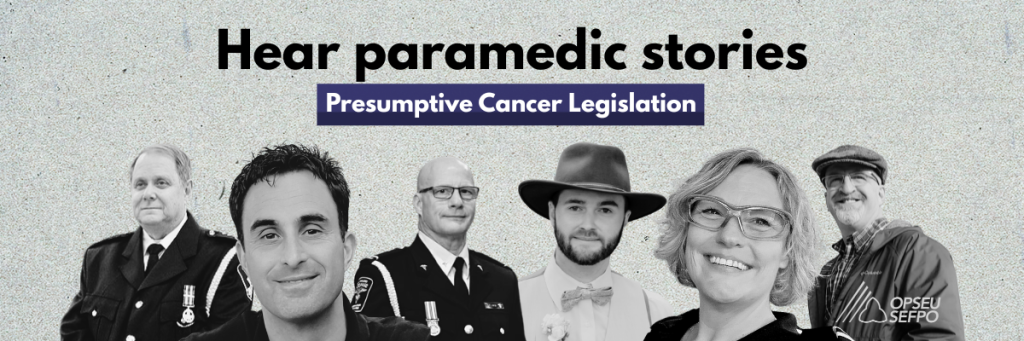
These interviews showcase the stories of six OPSEU/SEFPO paramedics who have received cancer diagnoses. While their worksites and experiences vary, the interviews share a common experience of intense circadian disruption caused by years of shift work. The International Agency for Research on Cancer classified night shift work as a probable carcinogen in several cancer sites including the breast, colon, rectum, and prostate.
“The care for the care provider has gotten much, much worse. I would not do it again if I knew this is what it was going to take from my life and my family.”

Dave Mills
Paramedic (on leave), 27 Years of Service
David Patrick Mills has been working as a paramedic since 1999. In his early days as a paramedic, Mills enjoyed the independence of working outside of building and the comraderie of working with partners. However, as his career progressed, he found that funding issues leading to fewer beds on the floors, longer offload times, and crew shortages all but nullified the advancements made in medications, technology, and training.
Mills recalls a time when he was stationed at a fire hall in London and had to hook his truck up to the same magnetic exhaust system used by all firetrucks: “We we’re laughing because none of our bases had this, whether it was diesel or gas trucks.”
In 2022, Mills was diagnosed with Stage 3 prostate cancer. Following his surgery, he measures time in the six-month increments between check-ups. He lives knowing that there is a thirty-five percent chance of the cancer returning after ten years.
“I enjoy taking away people’s pain. Giving them pain medication is one of my favorite things.

Laura Gillies
Full-Time Advanced Care Paramedic, 33 Years of Service
Originally trained as a nurse, Laura Gillies quickly realized that her calling was elsewhere. While serving as a clerk in the emergency department, Gillies found herself admiring the paramedics. She went back to school to become one herself, graduated in 1993, and has been a paramedic ever since.
For most of her career, Gillies has worked shift work. “Changing from nights to days is a very short changeover for us. It always left you feeling continually behind” says Gillies.
Four years ago, Gillies received a blood cancer diagnosis. She is currently no longer in active treatment but sees a specialist once per year for monitoring.
“One minute you can be working a car accident…the vehicle could be on fire, it could be smoking, there could be electrical wires burning.

Tim Alexander
Retired Paramedic, 32 Years of Service
After talking to a friend who was a paramedic, Tim Alexander decided to apply to paramedic school. He graduated in 1986 and instantly found himself drawn learning the skills of the trade and helping people “when they’re at their lowest.”
From car accidents to water rescues, Alexander has been exposed to chemicals, smoke, burning textiles, broken glass and many other hazards. Over his thirty-two-year career, he mostly worked a combination of twelve-hour shifts, nights and days, switching between them every two weeks. “I would probably get four maybe five hours of sleep on average,” he recalls.
Alexander was diagnosed on December 15, 2021 with prostate cancer. He is now cancer-free following several treatments including a prostatectomy and lymphadenectomy in 2022.
“You know, night shifts are a proven carcinogen as well. I’ve been doing night shift for 32 years.”
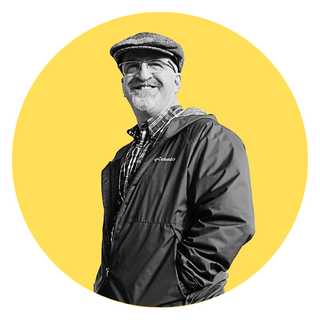
Don Black
Retired Advanced Care Paramedic, 35 Years of Service
In high school, Don Black witnessed a friend get into a motorcycle accident while entering the schoolyard. He was the only person around to help. After providing support to his injured friend, Black knew that becoming a first responder was in his future.
After starting training as a fire fighter, Black pivoted to paramedicine, preferring the autonomy. After beginning his career as a paramedic in 1990, Black officially retired in 2025. He was diagnosed with prostate cancer in June 2022.
Black had surgery in November 2022. “It’s now like three and a half years and the doc said at the time he was confident that he got it all… my blood work is stellar.”
“I did not file for WSIB [following my diagnosis]. It was already overwhelming with the amount of paperwork I had to do… just to get disability pay. “

Justin Buckle
Paramedic (currently on modified duties), 8 Years of Service
Justin Buckle is the first in his family to become a first responder. Never one for sitting still and working at a desk, he knew from a young age that he would end up in a career with excitement and spontaneity. “I like just the variety that comes along with paramedicine, says Buckle. ” “You show up for work, you don’t really know what could happen that day…not every day is the exact same thing.”
In April 2023, Buckle was diagnosed with acute myeloid leukemia (AML). He has been in remission for two years now. Testing revealed that his particular strain of AML was not genetic.
“I’ve been to pretty much any situation […] toxic situations, environmental. The current issue, with cancer, started before my retirement.”

David Woodcock
Retired Paramedic, 45 Years of Service
A series of traumatic childhood events caused David Woodcock to witness emergency services at work and planted the seeds of his interest in becoming a paramedic. However, it was not until many years later, while attending a friend’s wedding, that David struck up a conversation with a paramedic in attendance and made a career shift. Woodcock was hired on January 20, 1971 and worked until August 2016.
In 2015, Woodcock was at work when he went to the washroom and “peed pure red blood.” He was diagnosed with renal cell carcinoma shortly thereafter.