Printable PDF of Members’ Bargaining Guide
Bargaining for Power
You are a union member, and that means you have bargaining power.
Together we are a community of workers with the collective power to improve our working conditions and set higher standards for other workplaces.
Each and every member plays an important part in the bargaining process, because the people who do the work are the experts. You know what is working, what should be working better, and what would help to improve your workplace.
We build trust through respect for the full diversity of the members in the workplace. We’re all different and we all have something to contribute, including our life experiences, skills and insights.
So how does bargaining work? What is your role in bargaining? What can you do to help bargain a strong contract?
This Members’ Bargaining Guide will give you answers to these questions and many more!
Getting Organized

Standing up to power, like our employer, is a risk, and so being organized is essential.
Organizing is essential to effective bargaining. We have no power at the table unless a large majority of the workers are unified and ready to act. When workers are engaged in our workplace, we take back our power from the employer and create an opportunity for change. Only when workers have power can we bargain a strong contract and improve working conditions.
Organizing is different from mobilizing. The goal is to talk to a great majority of the workers by identifying organic leaders in the workplace. It is an ongoing, structured process that builds power over time, to reach maximum leverage at the bargaining table. This means we focus on organizing for many months before we file a notice to bargain. We also build our power over multiple rounds of bargaining.
Equity and Bargaining
Equity is a key part of organizing. Workers cannot reach their full power potential until we are all engaged and ready to take action to improve our lives and workplaces. We can make meaningful change when our solidarity includes workers from every job classification, every level of income, all Black, Racialized and Indigenous workers, and workers from across all demographics and equity-deserving groups.
Organizing involves identifying and reaching out to all equity-deserving groups in the workplace and establishing trust relationships. This includes identifying the organic leaders from all job classifications, cultural groups and Black, Racialized and Indigenous workers.
By ensuring no one is excluded, and that everyone is engaged and represented, we can accurately identify our top workplace issues and concerns. This is also how we reach broad support for our bargaining demands.
When we include equity in the bargaining process, we start to dismantle traditional racist systems and lift up all workers.
The Role of Stewards, Leaders and Activists

Workplace stewards are an important link between the bargaining team and the workers. While the bargaining team is busy at the table, the stewards are in the workplace having conversations and gathering feedback about how things are going on the ground. They are also continuing to build power through communicating, providing information and dispelling any rumours.
Not all leaders hold formal, elected positions in the union. Are you someone your co-workers turn to when they have questions? If so you’re a natural leader with the ability to change hearts and minds. It’s time to put those skills to work in building worker power.
All union activists play an important role in the workplace. Do you have communication and tech skills? Do you speak a second language? Do you have connections with community allies outside the workplace? All these skills are important for building worker power leading up to and during bargaining.
The Bargaining Spiral
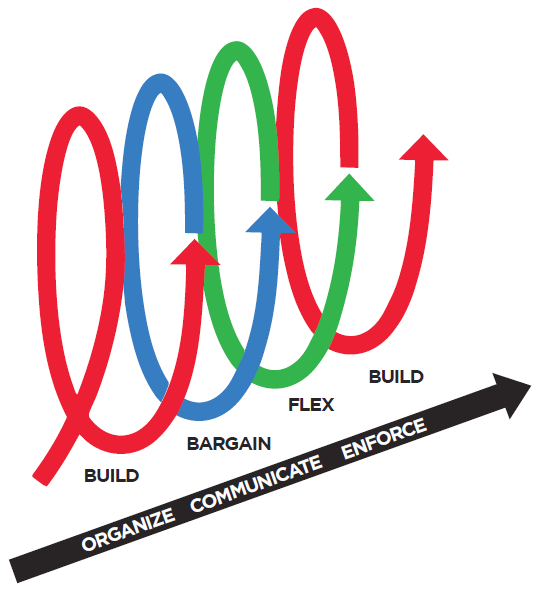
Over time, as we continually organize, communicate and enforce the collective agreement, we build worker power. We bargain our contract, flex our wins and build some more. This is how we gain better and better working terms and conditions as we move forward.
The Bargaining Process
The bargaining spiral provides the framework of a process for building worker power, negotiating the best possible contract and improving working conditions. Here is how we break the process down into actions.
Phase One: Build
We build the power of the bargaining unit through solidarity and collective action.
Key tactics include having one-on-one conversations and signing union cards. This is how we create relationships, share knowledge, and establish communication.
We maximize worker power by identifying leaders and mapping out the relationships in the workplace. These strategies ensure all workers from every job category and all demographics are included.
Those workplace leaders become the organizing committee and contribute to the mapping process through tracking conversations. Tracking allows us to assess our power in real time and is crucial to an organizing plan.
We create a strategic bargaining plan rooted in what’s at stake, what we are fighting for, and what it will take to win.
Phase Two: Bargain
Once we’re organized it’s time to prepare for bargaining.
The union files a notice to bargain up to 90 days before the expiry of the current collective agreement. We then send the employer a request for disclosure of financial and organizational documents including the budget and a list of employees.
The demand set process
The demand set survey is an organizing tool. The organizers ask all the workers to contribute details about how they want to improve the collective agreement. The bargaining survey questions come out of the organizing conversations.
The Local Executive Committee members can send out the demand set survey before the bargaining team is elected, or alternatively the bargaining team can do this.
The proposed demands are distributed at a demand-set meeting where the workers can vote on their priorities. The bargaining team together with staff use the priorities to draft the union proposals and shares them with the workers.
Negotiations begin
The team is now ready to meet face-to-face with the employer and start contract negotiations. Once the two sides reach a tentative agreement everyone at the table signs it. The union bargaining team schedules a ratification meeting for the members, and a democratic vote is held to determine whether it is accepted. If both the union side and the employer side vote in favour, we have a new collective agreement!
Phase Three: Flex
Once we have a new collective agreement, we flex by enforcing our new contract language, communicating our victories and celebrating achievements.
We also welcome and inoculate new workers and continue to build worker power through organizing and creative actions.
The labour movement is much larger than our local. We also participate in the broader labour movement including Area Councils, Labour Councils, the Ontario Federation of Labour and Canadian Labour Council.

What Is Collective Bargaining?
Because we are part of a union, we have a lot of collective power. We use our power to negotiate our terms of employment. Workers and the employer sit at the same table as equals, and negotiate wages, benefits and entitlements as well as equity rights, worker safety protections and more. The document we negotiate together is our collective agreement.
Our collective agreement is a legal document that enshrines our working conditions and is agreed to by both the workers and the employer. The workers ratify the agreement with a democratic vote.
Only unionized workplaces have a collective agreement. In non-unionized workplaces the workers must negotiate their wages and working conditions individually. This gives huge power to the employer.
Bargaining Strategy
Bargaining strategy is rooted in an analysis of the Strengths, Weaknesses, Opportunities and Threats facing the employer and facing the workers – commonly known as a SWOT Analysis. This work involves assessment of the broader bargaining environment including power structures, the political climate, and concurrent events that affect timing and actions. The SWOT analysis document is the road map we follow throughout the bargaining process: we build on our strengths, neutralize our weaknesses, optimize our opportunities and minimize our threats.
Strategic Organizing
There are proven organizing strategies that workers can use to build our power. These are useful actions to take in preparation for bargaining.
Mapping the Workplace
Workplace mapping is how we chart our community of workers and our progress in organizing. It is an essential part of building our collective strength. We get to know our coworkers, identify leaders and encourage workers to get involved. We also record engagement in planned workplace actions to measure our readiness for bargaining.
Identifying Leaders
When we map our workplace, we think about who the workers turn to for information. There are people in every workplace who are respected and trusted. They are the people workers go to with questions about their work and their life. They are colleagues who inspire their coworkers to take action. These are the organic leaders. They might be elected union stewards, or they may not be active in the union at all.
Organic leaders are key organizers who have influence with their coworkers. When they are working in solidarity with the union, they increase participation and strengthen the union.
Organizing Conversations
Organizing conversations are the way we engage our co-workers in the important work of the union including the bargaining process. There is a strategy to organizing conversations, and we get good at them when we practice.
A one-on-one organizing conversation includes more listening than talking. In an organizing conversation, we listen 70% of the time and only speak 30% of the time. Here is an outline of an organizing conversation you can have with your coworkers:
What are the workplace issues they are experiencing? How do they feel about these issues? Explain that management is responsible for making sure we have a safe and fair place to work. Inoculate your coworker by helping them understand what tactics the employer is using, and how we can push back with solidarity. Describe how we can make things better at work together, and what specific action we can take. This might include attending a union meeting or a workplace action. Get a commitment. Follow up later.
When workers have organizing conversations, we build relationships and increase worker engagement. The more workers participate and are prepared to take a stand, the more strength we have at the bargaining table.
Structure Tests
The structure of a workplace is the foundation of worker power and can be tested for solidity like the structure of a building. We do that by running structure tests, which allow us to measure participation outcomes.
Structure tests can include activities such as signing a petition, wearing a button, using a Zoom background with the bargaining slogan, or participating in an information session. A structure test can also be completing a demand survey or attending a general membership meeting.
The ultimate structure test is a strike vote.

Open Bargaining Tactics

Bargaining can include a variety of tactics that open the negotiations process to greater member participation. This is called open bargaining, and it builds trust and solidarity among the workers, which in turn gives us leverage at the table.
Open bargaining tactics can include frequent and transparent communications such as daily bargaining updates. We can also hold a hybrid negotiations table where members are invited to attend online. Another tactic is opening the doors to a large number of members attending in person. We can also create a variety of bargaining-related committees so that members can assist with developing agreement language, communications, equity representation and more.
Open bargaining includes applying an equity lens to the process of negotiations. We ensure everyone is participating, from every equity-deserving group, every job category and every work location.
Setting Demands
Workers know our workplaces and working conditions best. Through testing and enforcing our collective agreement, and having one-on-one conversations with other workers, we can identify what we want to improve in our collective agreement during the next round of bargaining. The bargaining team puts together a survey to help set the demands for all members of the bargaining unit. The results of the survey are compiled by the team, and then the members hold a meeting to vote on their collective bargaining priorities.
Costing our Proposals
Accurate costing provides a framework for calculating what we can successfully demand, and the rationale needed for negotiations.
We also work towards gains being fairly and equitably distributed. Equitable distribution of resources depends on knowing and understanding barriers and workplace divisions as well as the costs.
The knowledge needed for accurate costing comes from research, including comparison with other collective agreements. Factual data is central to determining fairness in cost demands and distribution.
Giving Notice to Bargain
When the union issues a notice to bargain, it triggers the employer’s duty to bargain.
For first collective agreements, we give notice to bargain as soon as possible after certification. For renewal of an existing contract, we give notice to bargain in the last 90 days of the existing collective agreement.

At the Bargaining Table
By the time we get to the bargaining table, we are well prepared. The workers are organized, and we have prepared a solid bargaining strategy. The support of the workers is key to the success of the bargaining team. We hold actions such as solidarity days and visibly support the team and create maximum leverage. The bargaining team also shares communications with the workers about progress at the table.
Organizing and communications committees are central to effective logistics at the table, for sharing vital information, coordinating strategies and actions to support the bargaining team, and ensuring the workers understand their legal rights and protections if there is a strike or lockout.
Pay Equity Negotiations
Pay equity is an ongoing process designed to ensure that employees in female job classes are not subjected to systemic gender discrimination in their compensation. A common misconception is that pay equity means workers should simply receive pay that is equal to others who are doing similar work – that is not the case. It is a very specific legal process with steps that are defined by statute. Pay equity negotiations and collective bargaining are separate, standalone processes.

Drafting the Collective Agreement
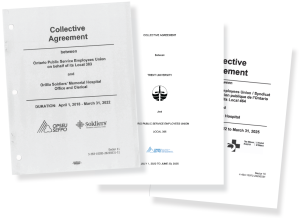
Collective agreement language is built on the demands of the workers. We determine the priorities for improving working conditions through research, organizing conversations and the demand survey process.
When we bargain, we use the existing contract as the model, and work to improve on the language it contains while refusing concessions. When we bargain a first contract for a newly organized bargaining unit, we find the best existing language from collective agreements of units where they do similar work.
Your collective agreement may include Addendums and Letters of Understanding. These are enforceable and subject to the grievance procedure. They are often bargained as a stepping-stone to getting an issue into the body of the agreement in the next round of bargaining.
An MOS must be completed for every round of bargaining and includes the changes to the collective agreement made during the current round of negotiations. In a first contract situation, the collective agreement itself will normally be the memorandum of settlement.
Conciliation and Mediation
We always do everything possible to build our power and settle contract negotiations at the bargaining table. We have the most leverage at the table and can get our strongest possible contract when we are face-to-face with the employer.
There are times, however, when the union or the employer will choose to file for conciliation with the Ministry of Labour. Then the Ministry appoints a conciliation officer to resolve the differences.
Typically, the union holds a strike vote before proceeding to conciliation. A strong strike vote gives the bargaining team a mandate to initiate strike proceedings if necessary. It also sends the employer a strong signal that we are serious and organized, and ready to withdraw our labour.
A conciliator can’t compel the two sides to reach an agreement. Their job is to facilitate getting to a deal. If no agreement is achieved in conciliation, either side could ask that the conciliation officer submits a No Board Report and the countdown begins to a strike. At this point the process moves from conciliation to mediation.The No Board Report is typically issued 3-5 business days after it is requested and once issued a 17 calendar day countdown begins toward a strike or lockout deadline.
Why and When Do Workers Go on Strike?
To get the best possible agreement, we show the employer that we have the power to make our demands. We demonstrate our power through collective action.
The strongest tool of the worker is withdrawing and withholding our labour. However, when we go out on strike, we first ensure that we are fully ready and prepared. This means we are organized!



What Is Interest Arbitration?
This is why we organize before interest arbitration occurs. Building our power and using it to campaign in advance of the arbitration process means we can raise the industry standards, and improve working conditions for our own bargaining unit, as well as for other workplaces in the same sector across the province.
Interest arbitration is mandatory for employees working in sectors that do not have the right to strike such as hospitals, correctional facilities, Canadian Blood Services and Public Health Ontario. These sectors proceed to interest arbitration to resolve any outstanding collective bargaining issues if bargaining comes to an impasse. Many OPSEU/SEFPO members working in long-term care facilities also do not have the right to strike, and Ontario paramedics have a limited right to strike.
Voting Procedures

A collective agreement must be ratified by a vote of more than 50% in favour.
The exception is where a collective agreement is resolved by interest arbitration. Where an arbitrator’s decision is issued, the result is final and binding.
Who Is on the Bargaining Team?
You elect your bargaining team from the membership of your bargaining unit.
Anyone who is a member of your bargaining unit can run for election to the bargaining team. If you know what the issues are in your workplace and you want to make positive change, you should consider running for your team. You can help make significant improvements in your workplace!
The team is elected during a union meeting well in advance of bargaining so they can get started with organizing, mapping, planning strategy and doing research. They receive bargaining team training so they can best represent the interests of the workers during negotiations.
Electing the bargaining team includes organizing in advance to ensure all equity-deserving groups are represented including Black, Racialized and Indigenous members.
For more information about upcoming bargaining, your collective agreement, or what being on the bargaining team involves, speak with your local elected leadership, such as a steward or your Local President.
Get Involved!
First of all, get signed up! When you sign a union card you will start receiving information about upcoming union meetings, and other important communications about how to get involved.
You can sign a union card by visiting https://hub03.opseu.org/Forms/emaweb.
Once you have your union card, you can visit the Member Portal to access services and member information and download a copy of your collective agreement. Visit members.opseu.org.