
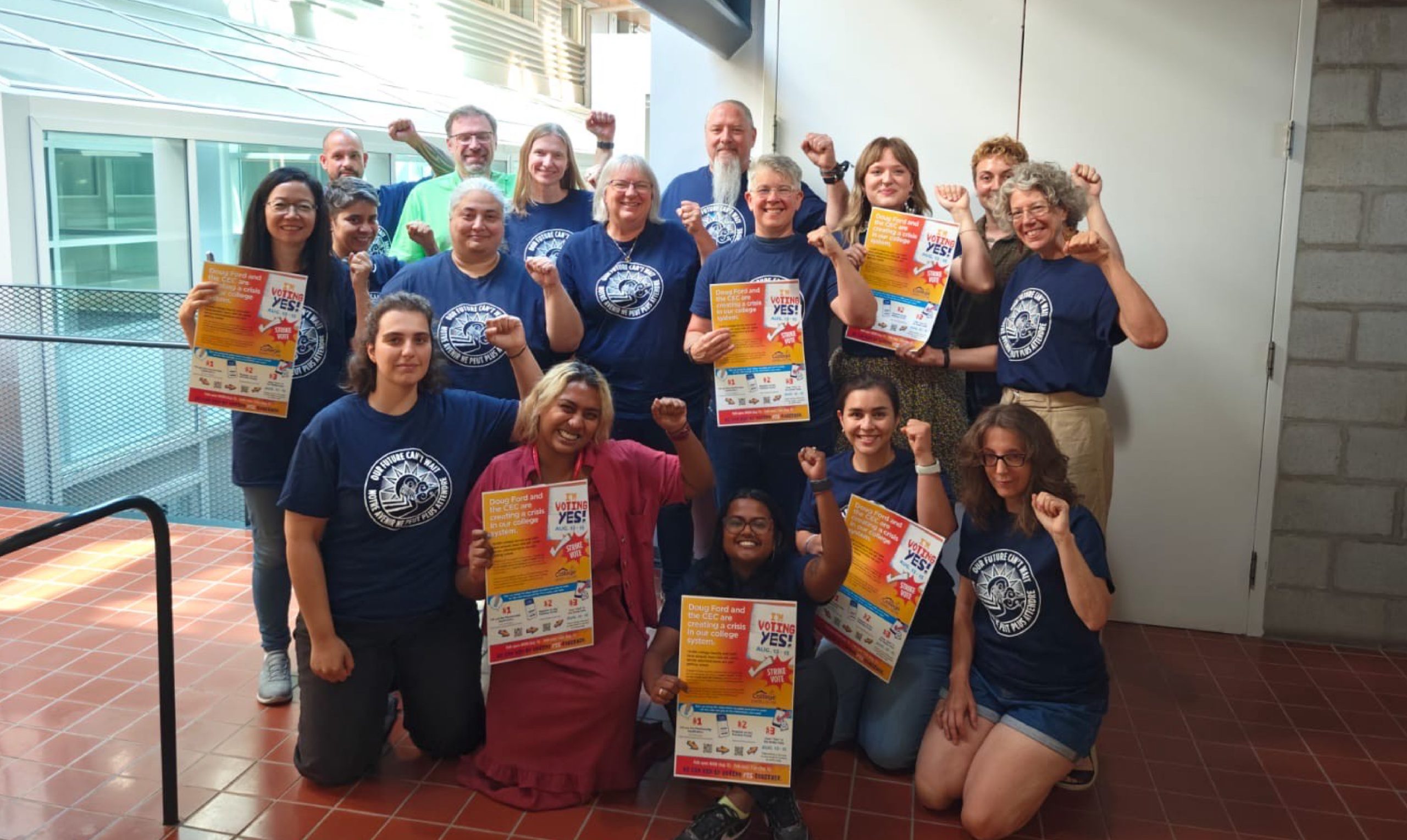
TORONTO, ON – The bargaining team representing over 10,000 full-time college support workers at all 24 of Ontario’s public colleges has requested a “no board” report this morning – putting workers in a legal strike position come the Fall 2025 semester.
“This fight is bigger than our contract. This is foremost a fight for college students, and what support will be left for them in the fall,” said Christine Kelsey, Chair of the bargaining team, who has worked at Algonquin College as support staff for nearly two decades. “Every demand we’ve put on the table to protect our work, also protects a job that supports a student.”
The union representing college workers, OPSEU/SEFPO, cites the lack of progress on securing job security for workers during one of the largest layoffs in provincial history, with 10,000 jobs cut and over 650 programs suspended/cancelled under the Ford government’s tenure.
“We are in a stark public funding crisis, where taxpayer money is being shifted away from the campuses that have graduated countless successful workers in our communities, and towards private training initiatives that cost taxpayers more with unclear results,” said JP Hornick, President of OPSEU/SEFPO and long-time faculty member at George Brown College. “Our kids deserve the same opportunities college grads did 10 years ago – and that’s just not the case anymore.”
The Skills Development Fund (SDF) has grown by $1.41 billion since 2021, reflecting the systemic shift of funds from colleges to duplicate programs by private providers, primarily based in the GTA through subsidies. The union notes that SDF funding now exceeds the college funding gap by 100 per cent, compared to government’s own Blue Ribbon Panel estimates.
“We have to protect what remains of our college system, so that we can rebuild,” added Kelsey. “Already, this fall, students are going to have fewer opportunities, more instability, and feel the effects of fewer frontline staff around to support them.”
The union fears that vulnerable students will pay the price as key student supports – from roles in financial aid offices, accessibility services, to college libraries – are eliminated. This comes at a time when youth unemployment and food insecurity in Ontario are at a record high.
In an effort to stabilize students’ experience, the union has tabled proposals to put a moratorium on campus closures and mergers, and prevent further layoffs for the duration of the collective agreement – proposals that have been rejected, Kelsey says.
“The conversation has now become: what do we do when campuses start to close? When students can’t access education without leaving their communities, let alone find their preferred program?” added Hornick. “The generational effects will be far worse: for hundreds of thousands of families, accessing a college education is the step ladder to a better life. What happens when that’s taken away?”
The “no board” report, once issued by the Ministry of Labour, Training and Skills Development, begins a 16-day countdown before any form of labour action can commence with five (5) days notice by either party.
No strike deadline is set at this time, but the union says that it urges the Colleges’ bargaining team to start negotiating with a real look towards improving the student experience.
“As for the Ford government, we put them on notice in July that we’re not going to sit idly back while public education is dismantled,” said Hornick. “What’s at stake is not just the future of this generation, but also generations to come. That’s something worth fighting for.”
For more information contact:
Vic Wojciechowska, OPSEU/SEFPO Communications
[email protected]