
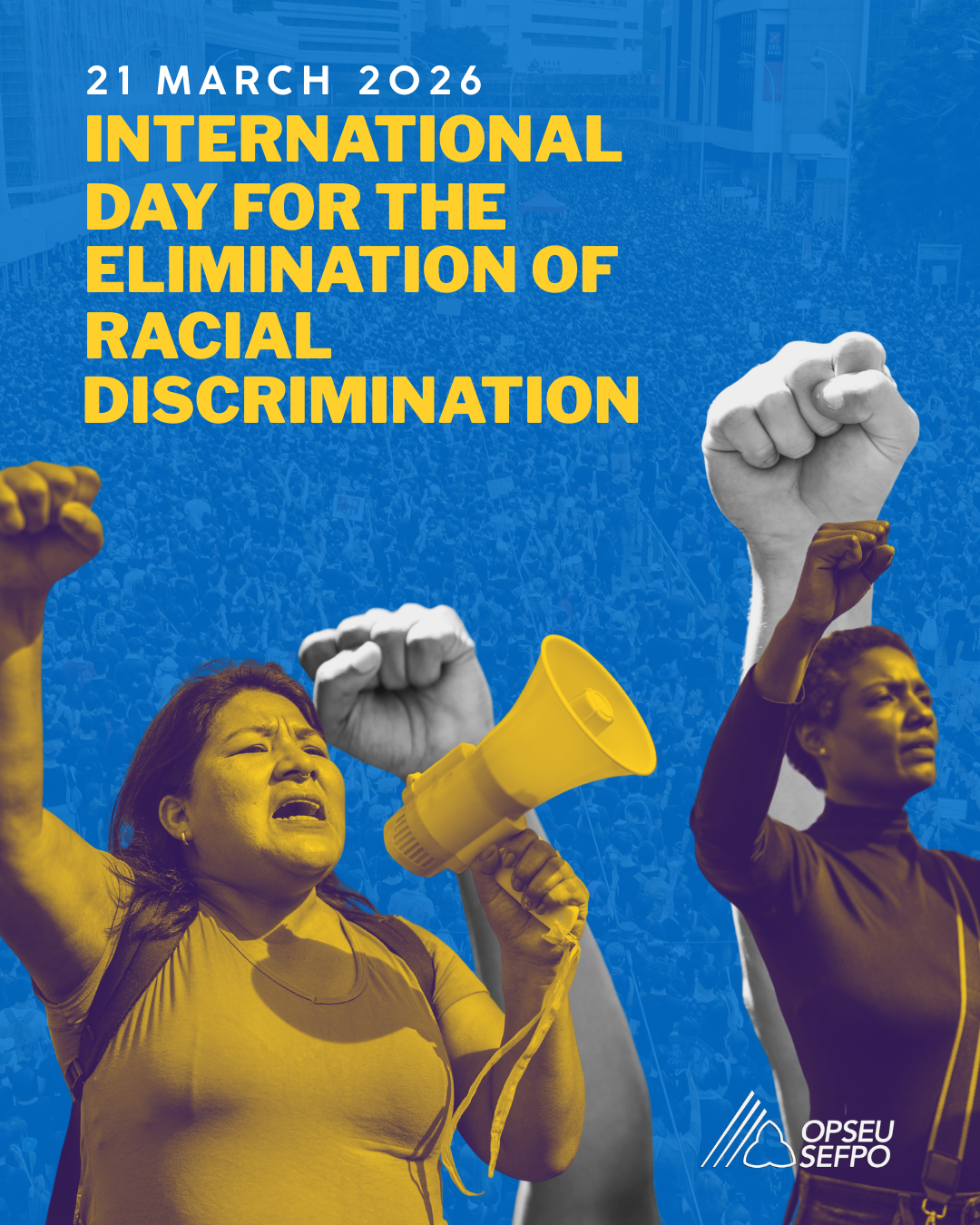
On 21 March 1960, a crowd of approximately 5,000 demonstrators gathered outside of a police station in Sharpeville, South Africa to protest the Pass Laws Act of 1952. Pass laws required Black South Africans over the age of sixteen to carry a passport-like document known as a ‘dompa’ at all times or face possible arrest and imprisonment. The dompas, like all other parts of the apartheid system, enforced a two-tiered society where racialized people faced segregation, discrimination, and attacks on their basic freedoms solely based on the colour of their skin.
In response to the protest, the Sharpeville police fired their weapons into the crowd of peaceful demonstrators, killing at least 91 people and injuring 238. This tragedy became known as the Sharpeville massacre.
In 1966, the United Nations proclaimed the anniversary of the Sharpeville Massacre, March 21, the International Day for the Elimination of Racial Discrimination, an opportunity to remember the Sharpeville massacre and the lessons it continues to teach us now.
On this year’s anniversary, the sixtieth anniversary of the International Day for the Elimination of Racial Discrimination, let us recall that the entire apartheid system was built upon white supremacy and the idea of the racialized ‘other,’ the belief that the colour of one’s skin made Black and racialized people culturally, socially, biologically, and intellectually inferior. In Afrikaans, the term dompas literally means “stupid pass.”
In Canada and in Ontario, we live with many parallels today. In Ontario colleges and universities, Indigenous, Black and racialized students report experiencing significant discrimination, xenophobia and targeting on campuses and in academic environments across the province.
In Ontario health care, research reveals differential treatment experienced by Indigenous Peoples and other racialized groups including but not limited to denial of service, service removal and reprisal. In criminal justice, data from the Correctional Service of Canada indicates that while Indigenous people make up about 5 % of the Canadian population, they account for nearly 30 % of new admissions to federal custody, and overrepresentation is more pronounced among Indigenous women. In Toronto, a Black person is twenty times more likely than a white person to be fatally shot by Toronto police.
As a union, we must never let March 21 become a day of lip service.
This is why in 2025 OPSEU/SEFPO launched its Dismantling Systemic Racism Program (DSRP), a training delivered to a broad cross-section of the union’s elected leadership and membership. To date, more than 4,500 of the union’s 8,400 elected leaders (53%) have completed the one‑day DSR training. In addition, over 200 staff have completed the train‑the‑trainer program, expanding the union’s internal capacity to deliver this work.
OPSEU/SEFPO has also committed funding to its employee resource groups (ERGs) enabling them to further racial equity initiatives, learning, and events. In the past year, ERGs delivered events and communications to recognize Black History Month, International Women’s Day, Asian Heritage Month, Pride Month, Indigenous Heritage Month and the National Day for Truth and Reconciliation.
Additionally, OPSEU/SEFPO recently began a new intranet series titled “Recognizing Diversity”. This series lists the days and months of significance to help promote inclusive practices and build understanding of diverse groups.
The International Day for the Elimination of Racial Discrimination is a reminder that every day is an opportunity to fight racial discrimination in our workplaces, in our communities, and in the systems that we encounter on a daily basis.
Today we recognize that, while apartheid didn’t officially end until nearly thirty years after the Sharpeville Massacre, it did eventually—and inevitably—come to an end. The refusal of those 5,000 demonstrators in Sharpeville to accept a two-tiered, white supremacist society was a critical step toward dismantling the oppressive apartheid system and creating a better future.