
By Wendy Lee, Local 575, inSolidarity Committee
On Saturday, Sept 12, approximately 35 online attendees and 18 in-person participants gathered at 100 Lesmill (OPSEU/SEFPO headquarters) for a groundbreaking workshop on non-apparent disabilities and workplace stigma
Organized through the collaborative efforts of the OPSEU/SEFPO Disability Rights Caucus and supported by OPSEU/SEFPO staff, this vital event challenged long-held myths, mindsets, and systemic barriers while identifying opportunities for real change.
Due to the overwhelming success and necessity of this educational opportunity, organizers plan to roll out this training to all seven OPSEU/SEFPO regions through the remainder of the year and into 2027.
The workshop broke the discussion down into four critical segments, exploring internalized stigma, interpersonal stigma, structural and workplace stigma, as well as collective responsibility and action. Through detailed definitions and an abundance of examples, attendees expanded their understanding of how disabilities impact our peers, facing tough concepts head-on to find a clearer pathway forward for everyone.
The Scope of Non-Apparent Disabilities
Understanding the broad scope of non-apparent disabilities is the first step toward dismantling workplace barriers. These conditions generally fall into a few major categories, including mental health conditions like post-traumatic stress injury, depression, and anxiety, as well as physical conditions such as lupus, rheumatoid arthritis, autoimmune diseases, and chronic pain. Neurological conditions like Parkinson’s, epilepsy, Multiple Sclerosis, and migraines also fall under this umbrella, alongside learning disabilities like dyslexia and ADHD, and chronic illnesses including diabetes, Crohn’s disease, fibromyalgia, and chronic fatigue syndrome.
It is crucial for union members to remember that all disabilities require deep understanding, regardless of whether they are apparent or hidden. These conditions can change over time, may be temporary or permanent, and can impact single or multiple facets of a person’s life. No matter how a disability manifests, every single one of them is fully protected under the Ontario Human Rights Code, and workers have a legal right to full participation without facing barriers.
Are we setting up workers with disabilities to fail in the workplace?
Unfortunately, many workplace attitudes, policies, and practices continuously disadvantage workers with disabilities by measuring them against a rigid, deeply flawed ideal of what a “good worker” looks like. This systemic ableism—whether conscious or unconscious—creates an unfair hierarchy by treating standard requirements, like tolerating noisy environments, communicating exclusively verbally, or working long hours, as the baseline for employment. This mindset reduces the perceived value of workers with disabilities and treats them as inferior. As union members, we must actively challenge these systemic assumptions. We need to question why workers are still being penalized for disability-related absences or medical appointments, and we must dismantle the harmful assumption that someone who looks healthy cannot have a disability. Furthermore, casual workplace stigma, such as making jokes or using ableist language like “crazy” or “psycho” must be completely eliminated from our shops to stop treating accessibility as an unearned privilege.

To help our locals identify and break down these power dynamics, several excellent educational resources are available. If your local executive or membership is interested in doing some group learning together, you can download the Reducing Stigma Activity Guide to access practical working exercises.
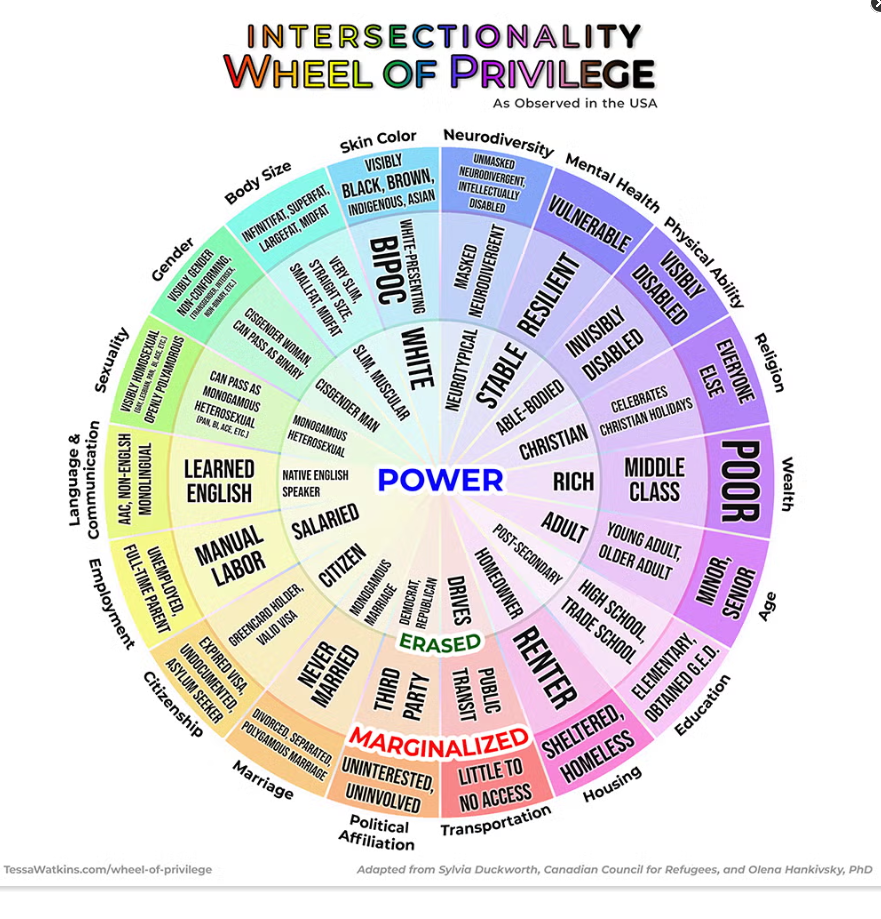
Where do you land on the Wheel of Power and Privilege?
Additionally, reviewing the Wheel of Power and Privilege provides an excellent visual and reflective tool used in equity and anti-oppression work. This resource maps out how intersecting identities influence a person’s level of societal power, demonstrating that those on the outer rings possess the least influence while those closer to the center hold the most privilege. Shifting our collective mindset means stopping the practice of benchmarking workers with disabilities against those without them, recognizing instead that when accommodations allow a worker to contribute safely, the entire workplace benefits.
Smashing through Workplace Accommodation Stigma
It is vital to establish that a workplace accommodation is a legally binding right, not a favour or a charitable gesture from management. The accommodation process is explicitly about identifying and removing the specific barriers that make doing a job difficult, focusing entirely on a worker’s functional limitations rather than a medical diagnosis. This shared, standardized procedural process involves the worker, the Union, management, and Human Resources to create a sustainable, reasonable, and safe working environment. Because accommodations are tailored to a worker’s unique needs through the principle of individualization, the worker must be fully integrated and included in every step of the planning. Throughout this process, strict privacy and confidentiality must be maintained by everyone involved. Once a suitable agreement is reached, a formal document is signed by the worker, the union, and the employer to provide a written account of what was tried, which can then be safely reviewed and adjusted over time if the accommodation needs to be amended.
While the employer has a management right to collect specific information to facilitate this process, they do not have a blank check to demand your entire medical history. The information shared should strictly focus on functional abilities, functional limitations or restrictions, and the estimated timeline for how long the support will be needed. Members should actively remind their treating healthcare providers to complete the necessary paperwork by providing only these essential details and nothing more. Furthermore, management cannot legally refuse a safe and appropriate accommodation based on mere inconvenience, customer preferences, or negative staff morale. An employer can only claim “undue hardship” and refuse to accommodate if they can prove the request meets at least one of three strict criteria: it is completely cost-prohibitive, it falls entirely outside of available funding, or it poses a direct threat to Joint Health and Safety measures.
Ultimately, achieving real, long-lasting change requires deep solidarity and a collective willingness to speak up for one another. As fellow colleagues and union activists, advocating for barrier-free workplaces is our shared responsibility, especially since any one of us could easily find ourselves needing an accommodation in the future. Because navigating the complexities of accommodation and disability rights can be incredibly challenging, you never have to face management alone. If you need direct assistance, advice, or representation, please reach out immediately to your Local Executive Committee, your sector WSIB representative, your local Joint Health and Safety Committee members, or the OPSEU/SEFPO Disability Rights Caucus.