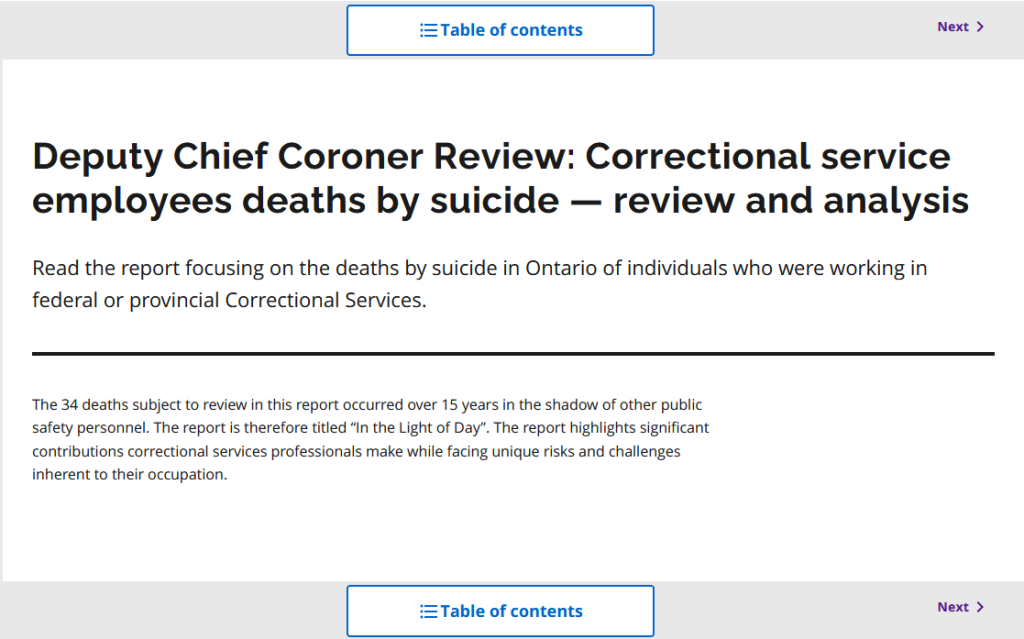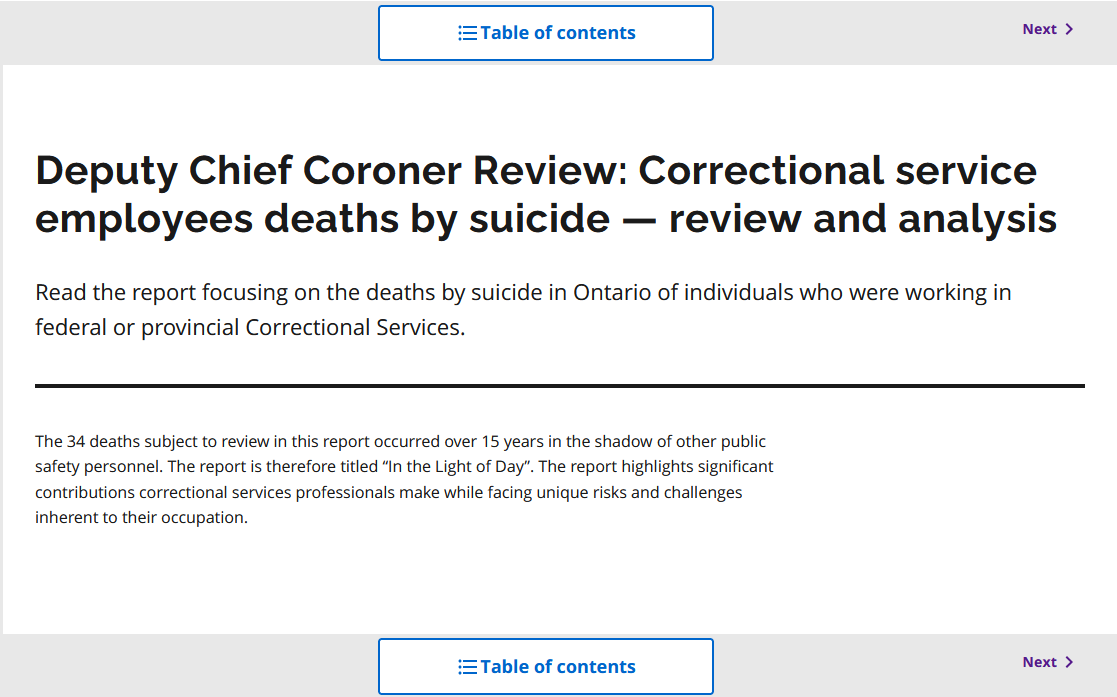
A disturbing new report on the alarming number of suicides among Ontario Corrections employees sends a clear message that the problem can no longer be ignored.
OPSEU/SEFPO’s Correctional Bargaining Unit is reviewing the “Light of Day” report by Deputy Chief Coroner Dr Reuven Jhirad, but it’s obvious that the Ford Government can no longer close its eyes to the problem.
“There is no longer any justification for delay, deflection or denial,” said a letter from OPSEU/SEFPO’s Corrections leaders that is part of the report. “The mental health of correctional workers must be a priority for the…province of Ontario, not in words, but through concrete, fully funded actions.”
The report reviewed 34 suicides over a period spanning from 2010 to 2024. The report made 28 recommendations including improved training, better mental health supports, and treatment programs.
A senior OPSEU/SEFPO Corrections leader says Ontario’s Corrections division has been “profoundly disappointed” with the provincial government’s failure to be there for workers who play a key role in keeping Ontarians safe.
“Their unwillingness to acknowledge the mental health crisis and failure to remove barriers to getting treatment has left our members shouldering the psychological toll of correctional work alone,” said Chad Oldfield, Corrections MERC co-chair and BMERC co-chair.
OPSEU/SEFPO has been raising the alarm for years about the working conditions in the province’s jails, including the rising number of post-traumatic stress and occupational stress-related injuries, as well as the alarming rates of inmate on inmate and inmate on staff assaults. The weight of the work can be crushing for Correctional Bargaining Unit members. These members need supports in place so they can access the appropriate treatment options, with the cost borne by the employer.
“In the last few years, we have lost too many of our corrections members to occupational stress injuries they sustained at work,” said JP Hornick. “Each and every one of these losses is felt not only by their families and friends who loved them, but also to every correctional worker and every OPSEU/SEFPO member. When you work in such intense conditions, you become like family, and any loss is felt by everyone.”
OPSEU/SEFPO’s Corrections leaders are grateful to the Deputy Chief Coroner’s office for stepping up to shine a spotlight on the issue and are going through the report’s recommendations in order to determine next steps.