
ImpacT: News for OPSEU members at MPAC from your leadership team
Volume 14, Issue 1, July 21, 2014
The plan without a plan…becomes a semi-plan
The journey down MPAC’s accreditation road has been a long one. It has been so long, we are beginning to wonder if at the end of it two hobbits are going to toss a ring into a pit of fire.
This past March, management revealed their new plans dealing with accreditation. They actually came up with a feasible solution. Rather than requiring all PA4s and PA5s to become accredited, management will be implementing a new “Super Assessor” position that will require applicants to have the required accreditation. No details on the rate of pay for this position or job specifications have been released, but the employer has been put on notice that said position must be negotiated with your union.
Just so people know, during this entire fiasco the union was in discussions with management, pointing out the pitfalls of their “plan without a plan” and continually trying to get answers for our members. It has been difficult to keep you, the members, up to date as we could never get a clear answer from the employer to any question we asked them. The theme through all of it was the union pointing out to management that they couldn’t unilaterally impose their accreditation “wish list” on our members without first bargaining the plan with the union.
This all dates back to the last round of bargaining. At that time, the employer tabled a proposal seeking mandatory accreditation. After some discussions on the issue, the employer withdrew their proposal.
We pointed out that management hiring practices, post-Futures, was to blame for where we are now. Case in point: Last year, when they handpicked over 20 individuals for PVS positions in Centralized Properties, less than half of them had any form of accreditation. As these people are supposed to be the "specialists," it would have been a good opportunity to promote the accreditation issue.
On September 12, 2012, during MPAC’s Province-Wide Meeting in Toronto, Antoni Wisniowski rolled out his victory statements which included reference to mandatory accreditation. However, no real details were provided as to how this would be accomplished. The impression was mandatory accreditation had been set in stone and if people didn’t like it, too bad.
With that announcement began a year and a half of upheaval and concern among the people working at MPAC. Of course, MPAC had to have a 100-day project under the guise of Rapid Results. After the third 100 day-project, it became apparent that there was nothing “rapid” about this process.
The union advised the members that most of the issues surrounding accreditation would have to be negotiated at the end of 2015 during the next round of collective bargaining. At the same time, the employer was reminded that this was a bargaining issue to be dealt with in the next round of negotiations. In the meantime, and as the result of the victory statements, members became overly concerned with the intent and implications of accreditation.
Later on, the UMC and the employer (in Wisniowski’s presence) met to discuss the concerns raised by the members over the issue of accreditation. Many of our questions were unanswered as the employer did not have a concrete plan at the time. However, Antoni did go into detail about the Rapid Results process and went on to say how useful it has been for the corporation. We had a much different opinion about how “useful” it had been in this case.
We again asked the corporation to provide more details and as a result, the union was asked to participate in some of the 100-day meetings. We agreed to participate for the sole purpose to seek answers to the questions raised by the members…not to negotiate accreditation provisions.
During the first phase 100-day project, MPAC wanted members to fill out their skills profile. While this was not mandatory, some MPAC managers decided to take the opportunity to strong-arm their employees to fill out their profiles. This did not go unnoticed by the union.
It became apparent early on that union members of the UMC were invited to the meetings only so it would appear the union was on board. The committee did not listen to any of the Union’s suggestions and then went on to start to make recommendations that the Union did not agree with. On the advice of our OPSEU staff negotiator, we resigned from the committee.
While the Union can appreciate MPAC’s lofty goals with respect to having an accredited workforce, we can also say that MPAC has caused much upheaval and concern among our members by not having a clear well-thought plan. We received many complaints that members were being pushed by managers to take accreditation courses (despite there was no obligation to do so) and that many more were being denied the four hours per week for completing assignments under the MPAC education policy. As happens so often at MPAC, the left hand and the right hand aren’t even attached to the same body.
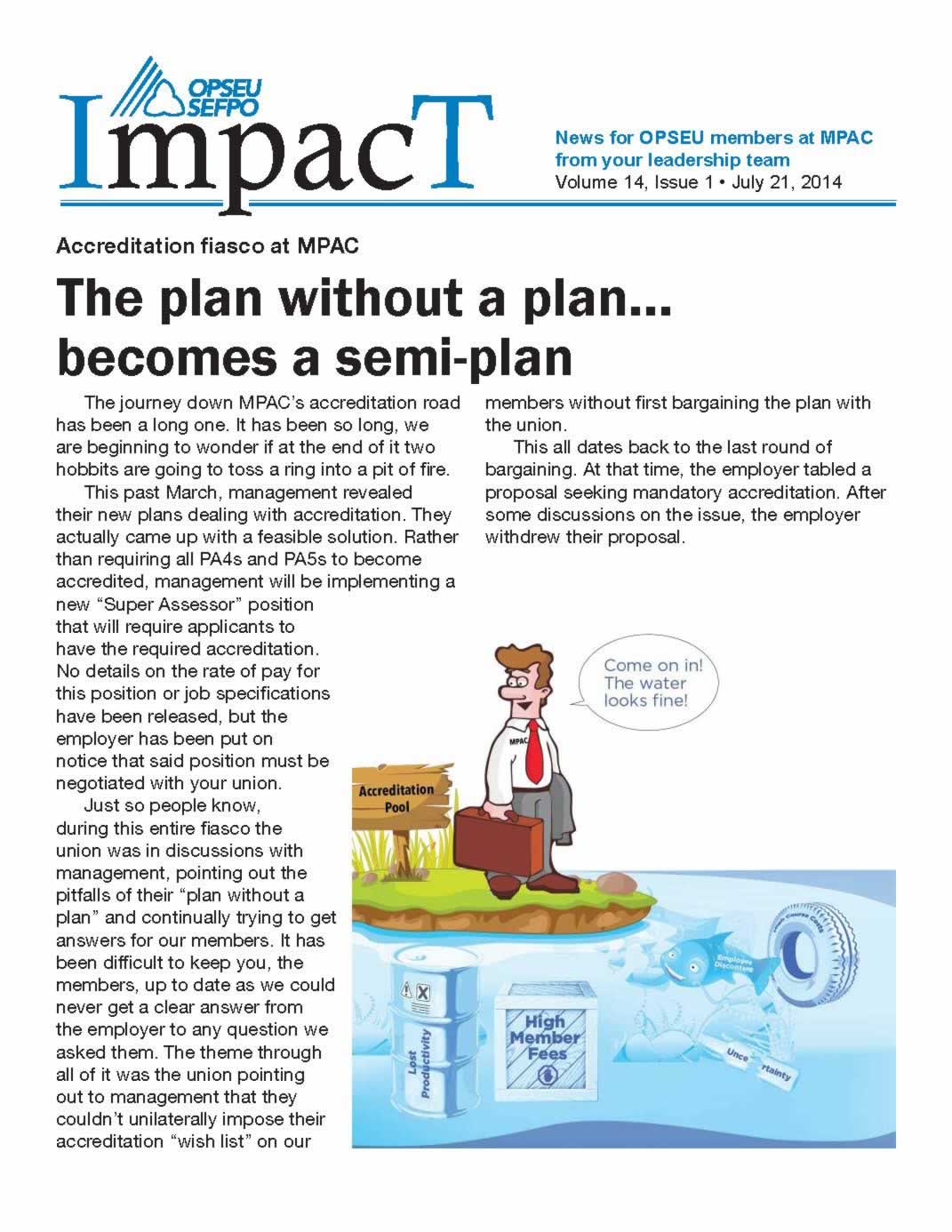
There are still many questions left unanswered by MPAC, questions that will have to be eventually answered. Here’s what we do know: This entire process, which accomplished little more than causing stress, uncertainty, anger, hostility, fear and anxiety, could have been completely avoided had the employer given this idea a little bit of thought and actually had honest, open discussions with the union.
We hope that maybe, just maybe, MPAC might learn a lesson from all this. We will know more once we begin bargaining a new collective agreement at the end of 2015, which is where negotiations for ANY new positions and accreditation must take place. In the meantime, we will keep asking questions, keep demanding answers and ensure the best interests of our members are addressed.
Stay in touch!
To ensure a speedy response to your questions, your leadership team has divided up all MPAC offices in the province. If you have a question or a comment, please contact the team member responsible for your office. Contact us by e-mail at work or at home, as follows:
David Lynch, Chair: Bracebridge, London, Mississauga, Ottawa, Barrie, Brockville, Cornwall, Pembroke, Trenton, Bancroft and Kingston
E-mail: [email protected]; [email protected]
Peter McClenaghan, Vice Chair: St. Catharines, Goderich, Chatham, Sarnia, Windsor, Kitchener and Brantford
E-mail: [email protected] ; [email protected]
Everett Kelly: Oshawa, Pickering, Richmond Hill, Toronto and Peterborough
E-mail: [email protected]; [email protected]
David Fong: North Bay, Sudbury, Sault Ste. Marie, Timmins, Thunder Bay, Kenora, Fort Francis and Dryden
E-mail: [email protected]; [email protected]
Steve Kovacs: Milner (CCC, CPF, LPU), Owen Sound, Hamilton and Parry Sound
E-Mail: [email protected]; [email protected]
OPSEU ImpacT is produced by the Property Assessment Division of the Ontario Public Service Employees Union and authorized for distribution by Warren (Smokey) Thomas, president.